Scientific article · Sources checked 2026-10-21
Auditing the Success Rates in an Eight-Week Melasma Cream Trial
A response rate needs its counting rule. Follow the differences between severity improvement, average score change and complete clearing before interpreting a cream’s results.
An editorial reading of public records. No clinician sign-off, patient outcome study, firsthand product test or examination of a supplied medicine is claimed.
The word success can make several different measurements sound interchangeable. A study might count how many people improve substantially, calculate the average change in a score, or record how many finish with no visible condition on its scale. A percentage attached to each answer has a different meaning. The Spot Check examines a triple-combination melasma trial by working backward from its results to the rules that produced them.
This is an audit of the evidence, not an allegation that a particular seller cites or misuses the paper. We read the full primary report alongside US prescribing information, a separate original sunscreen study and the FDA’s consumer notice. The aim is to identify which conclusions survive when the denominator, endpoint, comparator and observation period remain attached. Our editorial interpretation also distinguishes those clinical questions from the documentation needed to evaluate a product or a provider’s offer.
Follow the record
Study facts at a glance
Design: Randomized, double-blind, eight-week Chinese single-center analysis. Source 1
Study counts: 53 randomized, 52 analyzed, 44 completed. Source 1
Primary success rule: A decline of two or three Melasma Severity Scale grades. Source 1
Prescription context: Tri-Luma’s US label specifies short-term moderate-to-severe facial melasma treatment, not maintenance. Source 2
OTC context: FDA reports no approved or legally marketed over-the-counter skin-lightening products. Source 4
First identify the intervention behind the number
The topical combination contains hydroquinone 4%, tretinoin 0.05% and fluocinolone acetonide 0.01%. Those concentrations identify the formulation; they are not a recipe or instructions for use. A result for a combination belongs to the intervention evaluated as a whole. The presence of a familiar ingredient does not show that the same result would follow from that ingredient alone, a different concentration or another delivery route.
The choice of comparison also limits the interpretation. A vehicle comparison asks what happens when the active formulation is compared with its designated control under the study’s conditions. It does not directly compare every alternative a reader might consider. A comparison between two complete formulations answers another question again. To assign benefit to individual components would require comparisons designed to separate their contributions rather than an assumption based on the ingredient list.
For a documentary check, the CoreAge Rx Spot On review is a separate record to inspect. Its inclusion here does not establish a match to the trial or transfer the study’s outcomes. Our editorial interpretation is that the most useful first step is to write down the exact product identity before evaluating any number associated with an ingredient category.
Read the underlying chart data: download CSV or download the source-labeled chart.
Check which people remain in the denominator
Participants had moderate-to-severe melasma, predominantly epidermal, and were mostly women aged 33–55; all received cleanser, moisturizer and sunscreen. One untreated participant was excluded, and missing follow-up used last-observation-carried-forward. The latter is an analysis method: an earlier observation stands in for a missing later one. It keeps a record usable in the calculation, but it does not turn the unobserved later state into an observed one.
An enrollment count, an analysis count and a completion count therefore describe separate stages. This matters even before considering statistical tests. Dividing by completers answers a different question from dividing by the specified analysis population, and neither denominator should be substituted silently because it makes the percentage larger or smaller. A careful reader should be able to follow the path from entry into the study to inclusion in each reported outcome.
The shared skincare defines the experimental setting too. It would be an additional inference to assign the entire observed change to one cream in isolation from that setting. The broader review habit is similar to the one in our guide to exact active-ingredient records: retain the details that identify the comparison instead of reducing the evidence to a familiar name and an attractive number.
Restore the severity threshold to the headline
The severity scale runs from zero to three. A response based on movement across grades is different from an outcome defined by the final grade alone. Someone can move far enough to satisfy a change rule while retaining some scored severity. Conversely, reaching a particular final grade depends partly on where the person started. The rule is doing essential work; removing it changes what the percentage appears to promise.
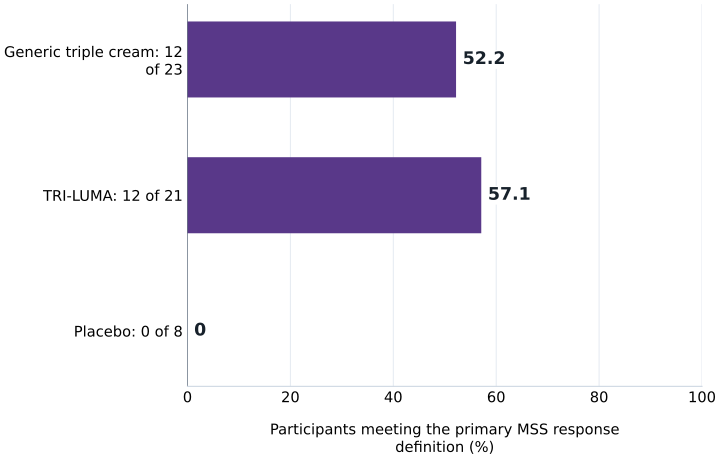
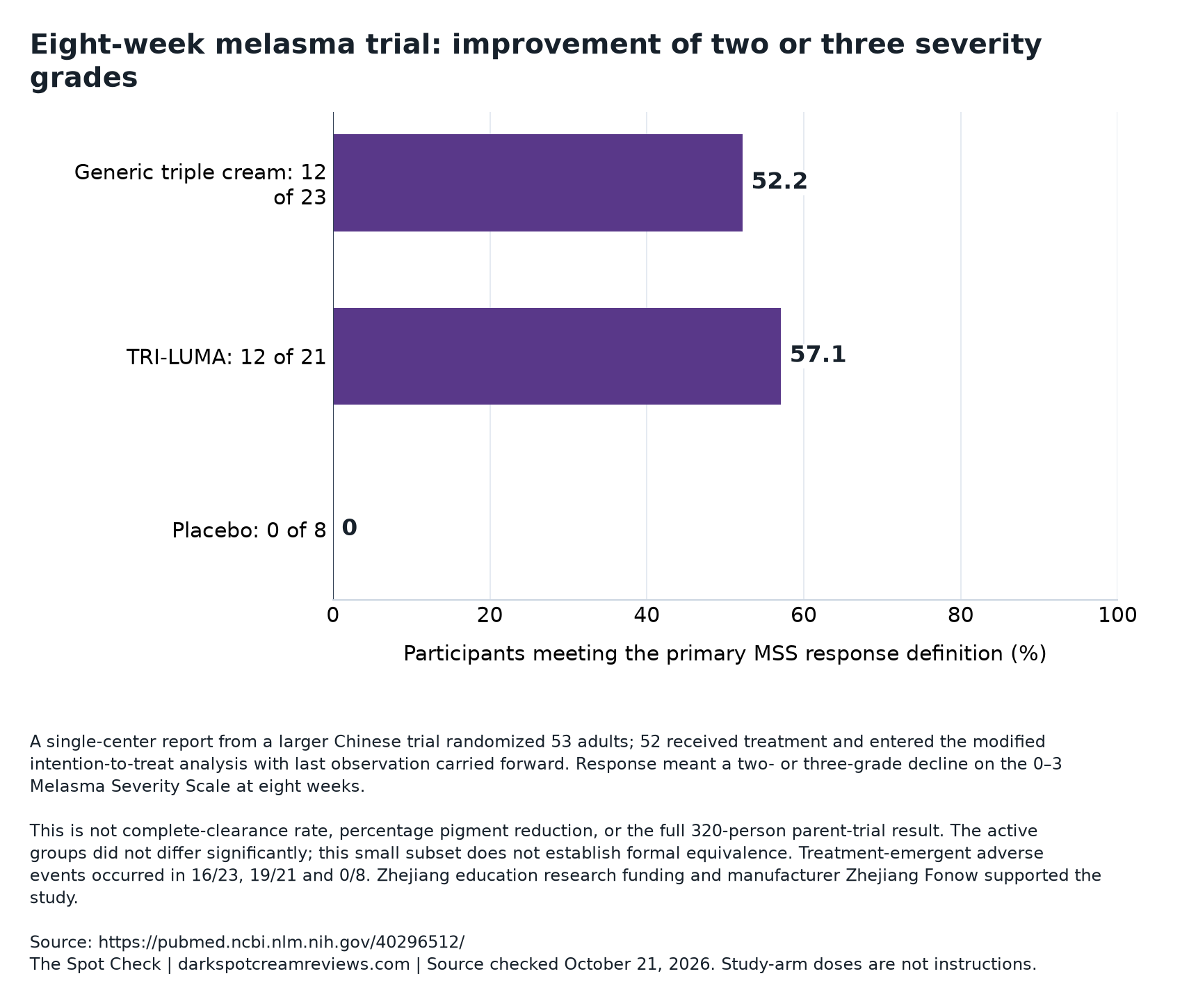
The table gives the primary result as both a fraction and a percentage. The fractions make visible that the numerator counts people, rather than an amount of pigment. They also explain why a decimal should not be mistaken for the resolution of the clinical examination. It is possible to calculate a decimal percentage from whole-person counts without measuring any individual’s appearance to that decimal place.
Our interpretation is that a headline should name the achievement being counted before describing the result as successful. That does not diminish improvement; it makes improvement interpretable. The testimonial-evidence guide approaches a related question: an account of a favorable experience cannot supply a standardized response definition, a denominator or a comparison group merely by sounding specific.
Primary response: decline by two or three severity grades, not complete clearing.
| Study group | Responders / analyzed | Percentage |
|---|---|---|
| Generic combination | 12/23 | 52.2% |
| Tri-Luma | 12/21 | 57.1% |
| Vehicle | 0/8 | 0% |
Do not replace a responder count with an average change
The Melasma Area and Severity Index (MASI) generates another set of summaries, shown below. A responder threshold turns individual changes into a yes-or-no classification. An average retains the size of changes but compresses their distribution into one number. Each sacrifices different information, which is why one cannot stand in for the other even when both are expressed with a percent sign.
Consider an explicitly invented example of four percentage changes: 10%, 10%, 90% and 90%. Their mean is 50%, and two observations meet a threshold of at least 50%. A second invented group has four changes of 50%. It has the same mean, but all four meet that threshold. The example is arithmetic, not a reconstruction of the trial. It demonstrates how a similar average can coexist with a very different responder proportion.
A third question concerns uncertainty. Variation among individual changes is not the same as uncertainty about the group estimate. A standard deviation describes the former; a confidence interval addresses the latter under the analysis assumptions. Changing that label would make the evidence appear to answer a different question. Neither a mean nor a responder percentage, on its own, tells a reader the expected outcome for a particular person.
Separate MASI summaries. The vehicle group’s mean percentage reduction was 24.7%.
| MASI summary | Generic combination | Tri-Luma |
|---|---|---|
| Participants with at least 50% improvement | 69.6% | 81.0% |
| Mean percentage reduction in score | 63.2% | 72.9% |
Keep clearance percentages in their own comparison
The US label’s two trials reported Tri-Luma clearing rates of 32/85 (38%) and 10/76 (13%), against dual-active combinations. Clearing required a severity score of zero. These are separate trials with a different success rule and comparison from the Chinese report. Combining the headline percentages into a single ranking would conceal those differences instead of explaining them.
A useful audit asks whether every number in a comparison describes the same event. If one is a change threshold and another is a final-state threshold, the event has changed. Next ask whether the alternatives were compared within the same experiment. Without that design, differences in participant selection, starting condition, assessment or concurrent care may be entangled with differences in treatment. Listing plausible influences is not proof that any one explains the observed results.
The label also notes that phototypes V and VI and other hyperpigmentation conditions were not studied. Such boundaries should remain questions rather than turning into assumed benefits or assumed failures. Our product-label question guide offers a documentary framework for keeping those issues visible. The scientific claim should remain narrower than a general promise about every concern described as a dark spot.
Ask whether similar numbers demonstrate equivalence
The active-arm efficacy comparison was nonsignificant, without established equivalence. A statistical test for a difference and a test of equivalence have different targets. To establish equivalence, a study must examine whether differences are confined within a justified acceptable range. Failure to detect a difference does not show that the range of plausible differences is sufficiently narrow.
For illustration only, imagine an acceptable range of five percentage points in either direction. An uncertainty interval extending from twelve points lower to twelve points higher would cross both boundaries. An interval from two points lower to two points higher would remain inside them. These are invented numbers, not clinical recommendations for an equivalence margin or estimates from this trial. They show why the interval and the predetermined boundary matter more than whether two headline percentages look close.
The conclusion also depends on what is being declared equivalent. Similarity on one response measure would not by itself establish equal tolerability, equal durability or equivalence for another condition. Our editorial reading is therefore to name the outcome and preserve uncertainty, rather than allowing a broad adjective to cover questions that were not resolved. An inconclusive comparison is still information, provided it is described as such.
Audit safety percentages with the same care
Treatment-emergent events affected 16/23 generic and 19/21 Tri-Luma participants; the overall comparison was nonsignificant. Irritation was 12/23 versus 17/21 (P<0.05). One Tri-Luma participant withdrew for exfoliation. The event-specific result should stay attached to that symptom. It cannot support a general declaration that one product is safer across every outcome or every period of use.
A person with several reactions can appear in several symptom categories but only once in a count of people with any reaction. That is why summing symptom percentages may double-count people. The timing and attribution rules matter as well: an event arising during observation is not automatically established to have been caused by treatment. Conversely, an event can be important to a participant’s experience even when its cause is uncertain.
The prescribing information separately warns about irritation, ochronosis, sulfite reactions and systemic corticosteroid effects. A trial table and a warning section serve different purposes; one should not be used to erase the other. A complete safety discussion asks what happened, how it was counted, how severe or persistent it was and whether it changed participation. None of those questions can be answered by replacing the record with a single reassuring adjective.
Do not extend an observation beyond its calendar
No skin atrophy or telangiectasia was reported over eight weeks. That observation describes the monitored period, not every possible duration of exposure. A short study may be informative about events that occur early and frequently while leaving later or uncommon outcomes uncertain. This is a question about what the design could observe, not a reason to discount all the observations it did make.
The label says melasma usually recurs after discontinuation. Sustained control requires a separate definition of recurrence and a follow-up plan that accounts for subsequent care. It is not established simply because improvement was present when a treatment-period assessment ended. To interpret persistence, readers need to know when its clock starts, which state is being maintained and whether other interventions enter the picture.
The five-month sunscreen study adds a different measurement question: its primary assessment used colorimetry, while the clinical mMASI comparison was nonsignificant between groups. It followed a different population. Our interpretation is that its longer duration cannot be borrowed to extend the cream trial, just as a color-contrast measurement cannot be substituted for a clearance rate. Different studies can inform a conversation without becoming one continuous experiment.
Trace the study’s support without guessing its consequences
The cream study received support from Zhejiang education grant Y201839775 and Fonow; Fonow supplied products. Authors declared no conflicts. For the sunscreen study, NAOS Ecobiology Company provided funding, and three authors were current or former NAOS employees. These are distinct records of support and affiliation. Reporting them accurately is more useful than inferring a funding relationship from an acknowledgment or omitting it because a result seems plausible.
Disclosure should lead to inspectable questions about the analysis. Was the central outcome clearly defined? Are missing observations addressed? Does the interpretation preserve the comparator and the uncertainty? Those questions apply regardless of who supported the work. Funding information alone cannot quantify bias, and a commercial connection does not establish that a specific result is false. The task is to examine where judgment entered the design and interpretation.
Our editorial inference is that traceability improves trust more than a blanket label of independent or sponsored. A reader should be able to locate the result supporting a sentence and see where the sentence becomes an interpretation. The same discipline is useful when two product pages describe a term differently: preserve the discrepancy and identify the supporting record, rather than silently choosing the version that makes the overall story more convenient.
Finish the audit at the boundary between evidence and offer
FDA’s notice records reports of rash, facial swelling and potentially permanent ochronosis involving hydroquinone skin-lightening products. Its OTC statement is separate from the approved prescription Tri-Luma label. It does not determine the regulatory status or clinical performance of an unexamined compounded product. A product-specific conclusion requires a product-specific record, not an inference from a shared ingredient name.
For that reason, the Dermatica review is linked as an invitation to inspect documentary terms, not as evidence that its formulation matches this trial or reproduces its results. A service description, a prescription label and a research endpoint answer different questions. Our interpretation is that a useful review keeps them connected through explicit evidence instead of blending them into one general endorsement.
Commercial terms deserve the same accuracy without being mistaken for clinical evidence. The pricing-conflict guide addresses discrepancies in an offer, while the category-comparison guide helps organize the product record. A price or purchase route does not establish efficacy. The final check is whether each sentence is supported by the right kind of source, with enough detail retained for a reader to understand exactly what has—and has not—been measured.
Questions about the evidence
Is the largest percentage the best summary of a study?
No single percentage is automatically the best summary. Start with the prespecified outcome and its definition, then examine complementary measures and harms. Choosing the largest number can substitute a different endpoint or a different denominator for the question the study was designed to address. A useful summary explains why its selected measure matters rather than letting numerical size make that decision.
Can a response threshold hide smaller improvements?
Yes, as a matter of measurement. A threshold classifies observations according to whether they cross a boundary; it does not describe every change below that boundary or the amount of improvement above it. That is why a responder result and a continuous score summary can be informative together. Neither should be relabeled as the other, and neither supplies an individual prognosis.
Why keep the control group in the explanation?
A comparison gives change its experimental context. Without it, improvement could be described but its interpretation would lose the alternative against which it was evaluated. The control’s identity matters too: a vehicle, another complete formulation and a partial active combination define different contrasts. An explanation should retain that identity instead of treating all studies with a comparison group as the same experiment.
Does no significant difference mean nobody changed?
No. A comparison between groups and a change within a group are different statistical questions. People in both groups can change while the study does not establish a difference between those changes. Equally, a significant change in one group and a nonsignificant change in another do not, by themselves, demonstrate a significant difference between the groups.
What should a reader verify before applying the result to a cream?
Identify the finished formulation, the condition being assessed, the comparison and the outcome relevant to the claim. Then check what remains undocumented about the proposed product or situation. That process can support a more focused clinical conversation without becoming a prescribing recommendation. Matching one ingredient or finding a favorable review does not complete the evidentiary connection.
What this evidence supports
Our assessment is that the trial becomes most informative when success is unpacked into its component questions. Who was counted, what rule did they meet, against what comparison and over which period? The answers support a more precise discussion of a combination cream than an isolated percentage can. They also explain why complete clearing, mean improvement, tolerability and lasting control should remain separate conclusions. A careful review preserves those distinctions and identifies the additional documentation required before a study result is connected to a particular product or care offer.
Research access and limitations
The analysis uses the full single-center cream report, official US labeling, the original sunscreen short report and the FDA notice. It does not treat unpublished parent-trial results as analyzed evidence, reconstruct individual outcomes, invent equivalence intervals or extract numerical values from sunscreen figures. The sunscreen supporting-information document is not represented as reviewed. Regulatory sources and the sunscreen funding footnote were checked October 21, 2026. Provider links are documentary navigation, not verification of a studied formulation or clinical outcome.
Return to the documents
- Efficacy and Safety of Generic Fluocinolone Acetonide, Hydroquinone, and Tretinoin Cream Compared With TRI-LUMA for the Treatment of Moderate-To-Severe Melasma in Chinese Patients: A Randomized, Single-Center, Placebo-Controlled Trial. ↗Full research article, with indexed abstract where available · Accessed 2026-10-21
- DailyMed: TRI-LUMA fluocinolone acetonide, hydroquinone, and tretinoin cream prescribing information ↗Full official prescribing information · Accessed 2026-10-21
- Comparison of Visible Light-Protective Tinted Sunscreen to Untinted Sunscreen to Protect Melasma Patients During Summer: A Prospective Randomized Investigator-Blinded Study. ↗Full primary research letter plus verified PMC funding footnote; supporting-information document and figure-derived numerical data not reviewed · Accessed 2026-10-21
- FDA warns consumers of skin products containing mercury and/or hydroquinone ↗Current FDA consumer safety notice, introductory safety text read; individual product-testing table is not used for provider comparisons. · Accessed 2026-10-21