Scientific article · Sources checked 2026-10-21
Auditing melasma sunscreen results: scores, contrast and the meaning of improvement
A sunscreen experiment illustrates why a changing score, a smaller color difference and a percentage of responders must keep their separate meanings.
An editorial reading of public records. No clinician sign-off, patient outcome study, firsthand product test or examination of a supplied medicine is claimed.
A claim that a treatment improved melasma is incomplete until it names the improvement. Was a skin measurement different? Did a clinical score fall? Did a specified number of participants cross a response threshold? These possibilities can produce very different numbers. The apparent simplicity of a percentage can hide the decisions that determine what belongs above and below its fraction line.
The Spot Check uses a tinted-sunscreen experiment to examine that problem. This is an audit of how research results should be interpreted, not an allegation that a particular seller has used the study in advertising. We follow the measurements and the comparisons before considering a success claim. A separate prescription-cream trial and official labeling then show why an endpoint cannot be exchanged for another merely because both concern facial pigmentation.
Follow the record
Study facts at a glance
Write the success rule before calculating a percentage
Our first audit question is what would qualify a participant as a success. A responder proportion requires an explicit rule, a count of people who meet it and a denominator. A change in a numerical measurement has a different structure. It compares values, and it may describe an individual or summarize a group. Adding a percent sign does not turn that measurement into a count of people.
Consider a purely illustrative example: six of ten people crossing a defined threshold would be a 60% responder proportion. A 60% reduction in one person’s measurement would answer a different question. Neither statement tells us that the other occurred. The observation period and treatment comparison are also missing from those short phrases. These invented numbers explain the arithmetic; they are not observations from the sunscreen study.
A useful claim retains those ingredients in a sentence a reader can check. The threshold should be stated independently of the result, and the population should remain visible. Our guide to testimonials and dark-spot evidence addresses a related distinction: a selected account of improvement cannot supply an experimental denominator. It may describe an experience without establishing how often that experience occurs.
Illustrative claims and the information needed to interpret them. No row presents an observed result from the sunscreen trial.
| Possible claim | Information required | What the number would describe |
|---|---|---|
| 60% were responders | Response rule; six qualifying people among ten assessed | A proportion of people meeting a threshold. |
| 60% reduction in a measurement | Starting value, follow-up value and calculation | A change relative to a measurement’s baseline. |
| 60% fewer recurrence events | Event definition, comparison group and observation period | A relative comparison of event frequencies. |
Read the underlying chart data: download CSV or download the source-labeled chart.
Read the clinical scores as scores
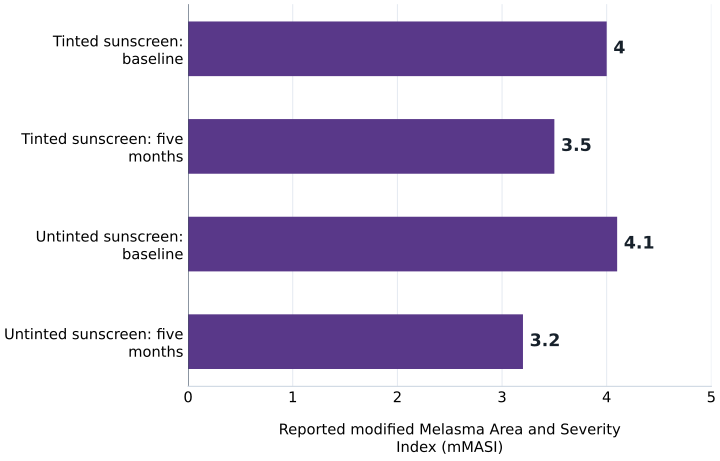
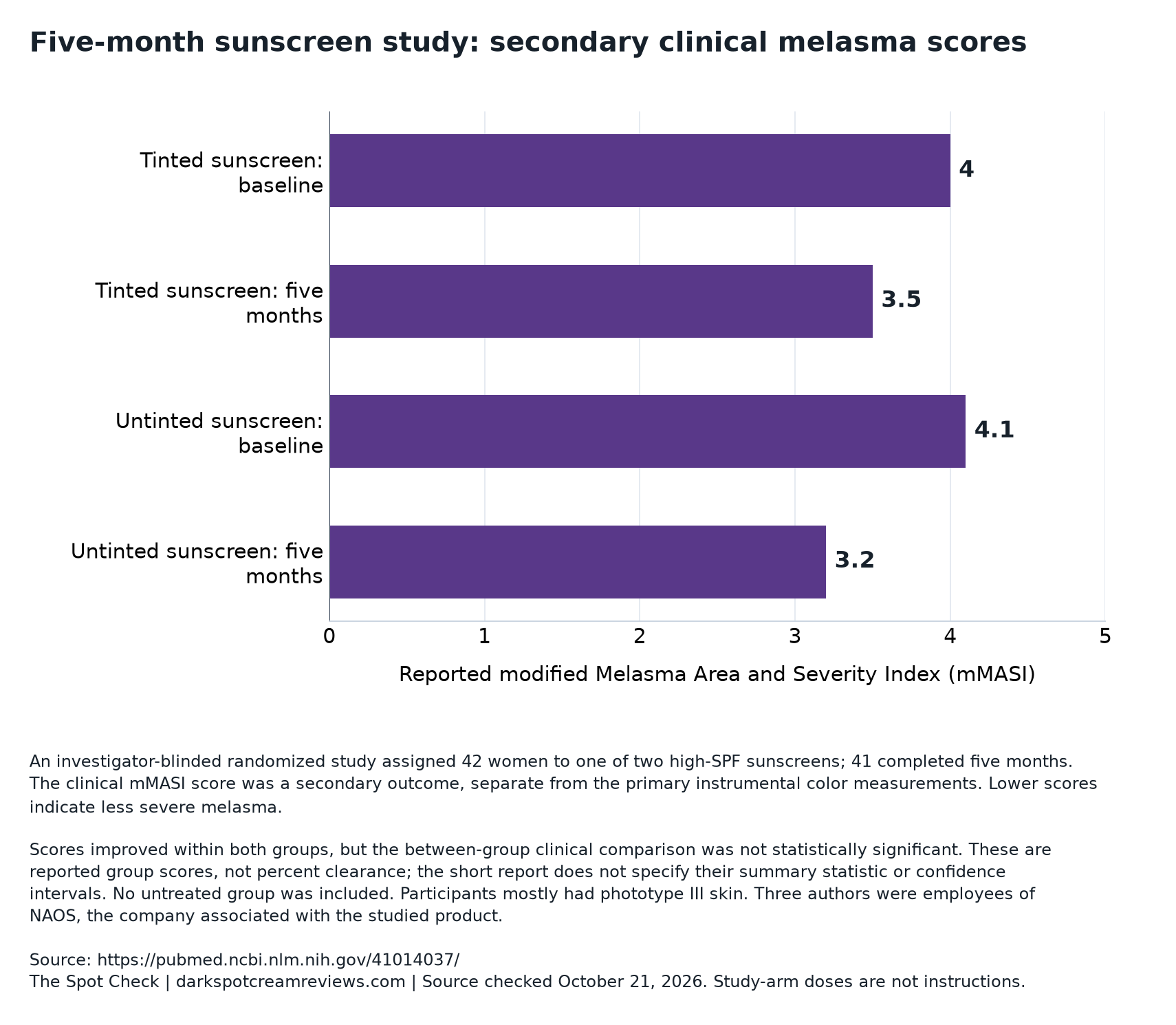
Reported mMASI values were 4.0→3.5 for tint and 4.1→3.2 for untinted sunscreen. Both within-group P values were <0.001; the between-group difference was nonsignificant. The summary statistic was unspecified. Our presentation therefore retains the wording group scores, rather than silently identifying them as means, medians or proportions.
There is useful information in the direction of these numbers, but the individual response distribution remains a separate question. A single group-level value cannot show whether changes were concentrated in a few participants or spread more evenly. It cannot identify which individuals crossed a clinical threshold. That information would require the underlying observations or a separately reported analysis, not a more elaborate description of the same chart.
A relative percentage calculation also needs an interpretable scale. Dividing a score change by its starting value may be mathematically possible without proving that the resulting percentage represents less disease in a clinically meaningful sense. Our audit asks what the scale measures and how the investigators intended it to be analyzed. The graphic’s job is to preserve the reported trajectory, while the surrounding explanation prevents a score from becoming a fabricated success rate.
A color difference contains two observations
Colorimetry preceded application. L* describes lightness; ΔE describes color contrast between affected and adjacent skin. Contrast measures improved significantly within the tinted arm, not within the untinted arm. The key interpretive issue is that a difference between skin areas includes information about both areas. It is not automatically a measurement of how much disease has disappeared.
Here is an editorial thought experiment. Imagine that an instrument reports identical readings for two neighboring patches at a follow-up visit. The gap between them is zero, but that fact alone does not reveal whether both became lighter, both became darker or they approached each other from different directions. The example concerns the logic of a difference, not the actual trajectories in this trial. The original values remain necessary for a fuller interpretation.
The same reasoning explains why greater uniformity and complete clearance need separate definitions. Uniformity concerns a relationship between measured areas. Clearance concerns a clinical state assessed under a stated rule. A research program could examine whether the two tend to occur together, but that association would itself require evidence. Our reading recognizes color contrast as an informative outcome while preserving the distinct question of how it relates to a patient’s condition and experience.
The comparison product determines the question being answered
The tinted formula was Bioderma Photoderm M SPF50+ Golden: pVL 66/UVA-PF 35/SPF 65. Untinted protection was UVA-PF 36/SPF 64. These labels refer to visible-light protection, ultraviolet A protection and sun protection factor. They characterize the tested products and should not be added together or read as percentages of melasma success.
Our interpretation of this design is that a comparison against another protective product asks about relative performance under the study conditions. It is different from asking what happens with no intervention. Keeping the comparator visible prevents a product characteristic from becoming a conclusion about every tinted preparation, every untinted preparation or the entire ingredient category. The experiment concerns particular products, not a contest between two words on a package.
A product record can help identify whether a proposed comparison is even about the same preparation. The guide to active names in dark-spot products explains why shared terminology needs exact product context. Scientifically, a matching ingredient name is a starting point for investigation. Evidence about concentration, formulation and measured performance is still needed before a result can be carried over to a different finished product.
Count the participants without inventing missing groups
Participants were 28–58 years old (mean 39.5), with phototypes III (93%) and IV (7%). Investigators were blinded. There were 41 completers after one pregnancy withdrawal; final arm-specific counts were unreported. These facts describe the observation set. They do not provide a basis for assigning the missing participant to an arm or calculating an unreported subgroup result.
Our interpretation distinguishes assignment, observation and generalization. Random assignment supports a comparison between treatment strategies within the trial. Observation determines which measurements are available for analysis. Generalization asks whether the result applies to people outside the study population. A strong feature in one area does not remove uncertainty in another: careful assignment, for example, does not make an unstudied population appear in the data.
Completion is also different from response. Returning for a final measurement does not imply improvement, just as a withdrawal does not automatically establish treatment failure or a product-related harm. Those classifications require their own definitions and evidence. An accurate success percentage would identify the analysis population and explain how missing results were handled. Our audit preserves the reported counts and leaves the unavailable arm breakdown unresolved instead of making the numbers look more complete than they are.
A significant change is not the same test as comparative benefit
Baseline values were imbalanced. The methodological question is how a treatment comparison accounts for the starting position, rather than assuming that two groups begin with identical opportunities to change. A final measurement, an amount of change and an adjusted comparison can answer related but distinct questions. Their interpretation should follow the analysis that produced them.
Suppose two hypothetical groups both show improvement, but one estimate is more precise than the other. A within-group significance test might label only one change significant. That pair of labels does not establish that the treatments differ. The comparison between treatments needs its own estimate and uncertainty. This is a statement about statistical reasoning, not a reconstruction of the unreported individual data from the sunscreen experiment.
Our audit therefore looks for the magnitude of the relevant contrast and a confidence interval, which expresses uncertainty around that estimate under the analysis. A small P value alone does not provide either a clinically important effect size or an equivalence finding. Numerical plot estimates and confidence intervals have not been reconstructed for this article. The full short report supports a bounded interpretation; its supplementary methods have not been independently examined here.
A recurrence claim needs an event and a clock
No untreated group was included. That limits how the study can inform an absolute prevention claim. A comparison between active products does not reveal the frequency of recurrence that would have occurred without either one. Assuming that missing course would turn an unobserved alternative into evidence, so our interpretation leaves it as a separate research question.
The word recurrence also implies an earlier state from which a return can be identified. A rigorous claim needs a definition of initial control, a rule for recognizing return and a time origin for follow-up. A scheduled skin reading can contribute information, but it does not automatically establish the timing or number of recurrence events. Extending a short description of appearance into a lasting-control claim requires those additional pieces.
The US Tri-Luma label concerns short-term treatment of moderate-to-severe facial melasma and does not indicate maintenance use. That prescribing boundary is separate from the sunscreen comparison. In our interpretation, evidence from these records can inform different parts of a care conversation without constructing a combined treatment plan. A useful long-term research question would specify what sustained control means and measure it directly, rather than assume a favorable measurement at one visit supplies the answer.
Different trial thresholds produce different kinds of percentages
In the separate Chinese cream trial, the primary eight-week criterion was a two- or three-grade decrease on the Melasma Severity Scale (MSS): 12/23 generic-cream recipients and 12/21 Tri-Luma recipients met it, reported as 52.2% and 57.1%. The label’s pivotal trials instead defined success as MSS zero, or cleared. These criteria cannot be exchanged when reporting a percentage.
Our detailed triple-combination trial analysis examines that prescription study. Its response figures have an explicit numerator and denominator, unlike the sunscreen score trajectory. Even so, a responder proportion is not a percentage of pigment removed. A person crossing a threshold contributes one to the numerator regardless of how far beyond it the individual change extends. The threshold shapes the result.
The table makes the distinction explicit. It is a comparison of outcome definitions, not evidence that one treatment is more effective than another. A valid head-to-head ranking would require a suitable direct comparison, or a justified broader analysis with compatible populations, treatments and outcomes. Placing unlike percentages next to each other does not create that analysis. In our audit, the endpoint definition travels with every result, including when the product names happen to overlap.
The same clinical topic can produce different outcome units. These records are shown to clarify definitions, not to rank treatments.
| Research record | Outcome definition | What the result represents |
|---|---|---|
| Sunscreen study | Primary instrumental colorimetry | A measured pigmentation characteristic. |
| Chinese triple-combination study | MSS decrease of two or three grades | People reaching a specified improvement threshold. |
| US Tri-Luma label trials | MSS zero at assessment | People classified as cleared. |
Safety statements and funding belong in the audit
Both sunscreens were described as well tolerated, without comparative adverse-event counts. Three authors were current or former NAOS employees, and Thierry Passeron disclosed industry honoraria. Alongside the funder identified above, these are documented features of the report. They should remain visible without being converted into unsupported conclusions about either safety or the validity of the experiment.
Our safety interpretation asks how events were sought, defined and attributed. A general tolerability description does not supply an incidence rate or a reliable estimate of rare harms. Equally, a lack of numerical detail is not evidence that an adverse event occurred. The appropriate response is to identify the missing safety information, rather than assign a risk value that the report never measured or presented.
Commercial funding makes independent scrutiny particularly relevant: readers can ask about outcome selection, reporting completeness and access to underlying data. It does not, by itself, answer whether the comparison was well conducted. Prescription warnings also remain product-specific. Tri-Luma labeling describes irritation, hypersensitivity and ochronosis, a blue-black discoloration; those warnings should not be relabeled as events in the sunscreen trial. Our audit keeps documented relationships, observed experiences and regulatory precautions in their respective records.
A product review should preserve the unanswered question
FDA states that OTC hydroquinone skin-lightening products lack approval for safety and effectiveness and cites reports of rash, facial swelling and potentially permanent ochronosis. That notice is distinct from the approved prescription Tri-Luma product record. It does not identify the status of an unspecified compounded cream or establish mercury contamination in an untested product.
Our editorial interpretation is to avoid letting a research citation fill gaps in a seller’s documentation. The product-label questions guide identifies the kind of unresolved detail that should remain explicit. Documentary reviews of Dermatica and Musely can help readers examine product and service records. These links imply neither access to the tested sunscreen nor transfer of its outcomes to those providers.
The final audit question is whether the claim still means what the evidence measured. If the product, population, threshold or comparison changes, the connection needs to be explained rather than assumed. A transparent review can state what is known and name the exact missing fact. That is more useful than presenting a percentage whose underlying rule has disappeared, because it allows a reader or clinician to identify what information would actually resolve the uncertainty.
Questions about the evidence
Can a lower group score tell me the percentage of people helped?
It cannot supply that percentage on its own. A count of people helped requires a defined response rule and individual outcomes classified under that rule. Our interpretation treats the group score as a measurement summary and the responder proportion as a separate analysis, even when both concern improvement.
Does a smaller color gap prove that melasma has cleared?
A gap describes the relationship between two measured areas. Clearance requires a separate clinical definition. In our methodological reading, color uniformity may be informative without settling that clinical state. A study would need to test the connection rather than assume the two outcomes are interchangeable.
Why not call two products equivalent after a nonsignificant comparison?
A failure to establish a difference can coexist with considerable uncertainty. Equivalence requires an appropriate design and a defined range of differences considered acceptable. Our audit looks for that framework before using the word equivalent, rather than treating an ordinary significance test as proof of interchangeability.
Does commercial sponsorship mean the results should be discarded?
Sponsorship identifies a relationship that deserves scrutiny, not a verdict about every result. Our interpretation asks whether the methods, outcome choices and available reporting support the claim. The documented funding and author relationships should be disclosed while the scientific analysis is evaluated on its specific strengths and limits.
What makes a treatment-success claim easier to check?
A clear claim names the tested product, population, response definition, comparison and time period. It also identifies the relevant uncertainty. That structure lets a reader trace the percentage to its original meaning and recognize when additional evidence would be needed for a personal care decision or a different product.
What this evidence supports
The most informative result is the one whose definition survives the headline. Our assessment is that the sunscreen findings should retain their measured units and comparative limits, while prescription-study percentages should retain their response thresholds and denominators. Color contrast, clinical scores and clearance classifications each contribute a different kind of information. The Spot Check’s audit does not turn those differences into a universal ranking. It uses them to identify whether an apparent success claim is supported by the outcome actually measured, and to make the remaining research or product question precise enough to investigate.
Research access and limitations
This article uses the full short sunscreen report, including its funding footnote, the separate Chinese triple-combination paper, current official Tri-Luma labeling and FDA’s consumer notice. Sunscreen supplementary methods and numerical values within figures were not independently extracted. Hypothetical arithmetic and measurement examples are editorial explanations, not participant data. No individual regimen or provider outcome is inferred.
Return to the documents
- Comparison of Visible Light-Protective Tinted Sunscreen to Untinted Sunscreen to Protect Melasma Patients During Summer: A Prospective Randomized Investigator-Blinded Study. ↗Full primary research letter plus verified PMC funding footnote; supporting-information document and figure-derived numerical data not reviewed · Accessed 2026-10-21
- Efficacy and Safety of Generic Fluocinolone Acetonide, Hydroquinone, and Tretinoin Cream Compared With TRI-LUMA for the Treatment of Moderate-To-Severe Melasma in Chinese Patients: A Randomized, Single-Center, Placebo-Controlled Trial. ↗Full research article, with indexed abstract where available · Accessed 2026-10-21
- DailyMed: TRI-LUMA fluocinolone acetonide, hydroquinone, and tretinoin cream prescribing information ↗Full official prescribing information · Accessed 2026-10-21
- FDA warns consumers of skin products containing mercury and/or hydroquinone ↗Current FDA consumer safety notice, introductory safety text read; individual product-testing table is not used for provider comparisons. · Accessed 2026-10-21